
Nobody retires to a golf community to spend more time with their accountant. You retire there for the 8:10 tee time, the patio after the round, and the quiet joy of never setting another Monday alarm. But the state where you plant your flag decides how much of your pension, IRA and Social Security check actually reaches the pro shop. The gap between states is not a rounding error. On a comfortable retirement income, picking the right state can be worth several thousand dollars a year. That buys a lot of range balls and at least one regrettable driver.
The timing is good. 2026 has been a big year for state tax cuts. Georgia, North Carolina, South Carolina and Mississippi all lowered their rates, and West Virginia stopped taxing Social Security. That leaves only eight states that tax Social Security at all.
What Actually Makes a State Tax Friendly
Most "best tax states" lists stop at income tax. That's like judging a course by the yardage on the scorecard. Golf community buyers should look at four things:
-
Income tax, and especially how the state treats Social Security, pensions and IRA or 401(k) withdrawals
-
Property tax, which you pay in good markets and bad, and which pays for nearly everything in a no-income-tax state
-
Sales tax, which hits every dinner, every new driver and every golf cart
-
Estate and inheritance taxes, which your kids will care about a lot more than you will
With that scorecard in hand, here are the states that play best for golf community living.
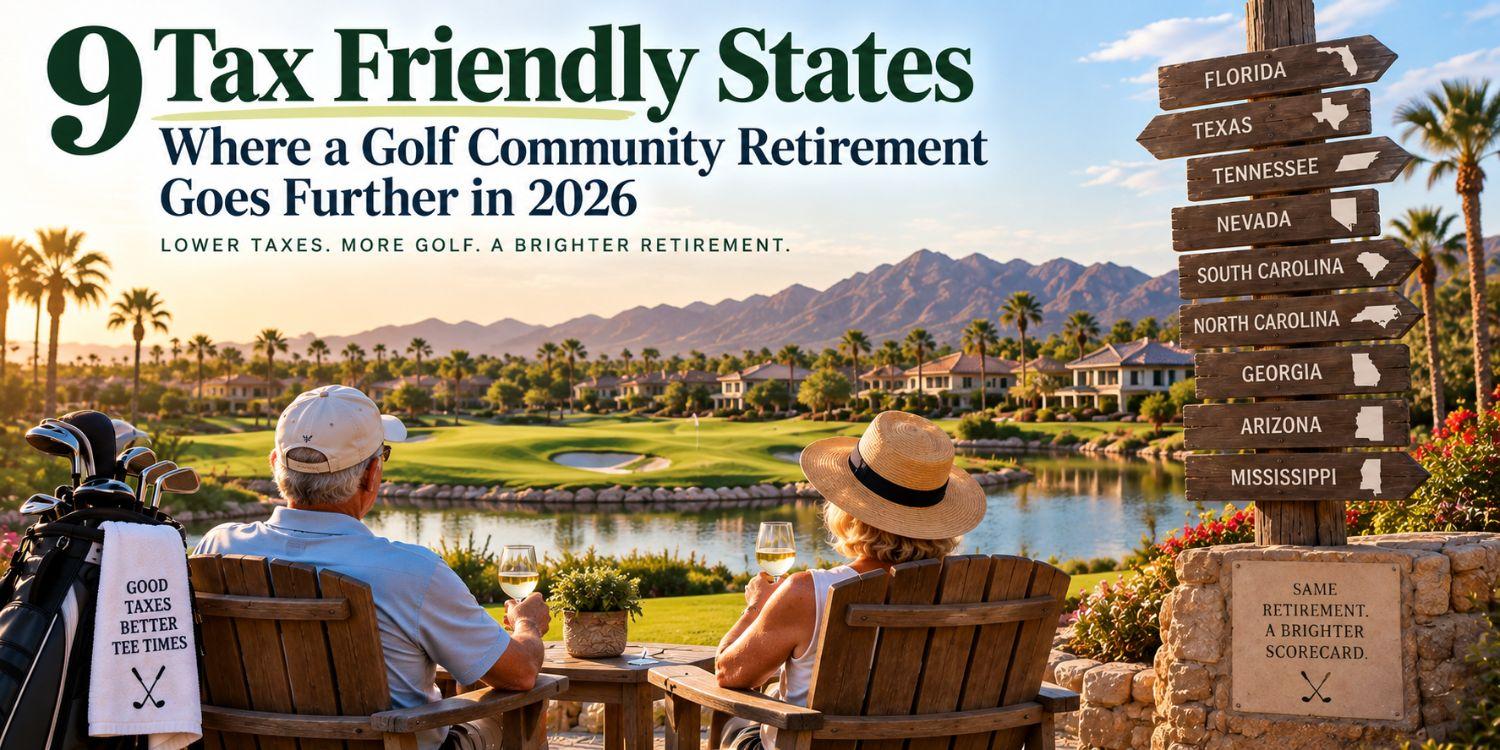
1. Florida
Florida is the default answer, and for good reason. It has no state income tax, no estate tax and no inheritance tax. It also has more golf courses than any other state, which is convenient. Primary homes get a homestead exemption (currently a little over $50,000 of value), and the Save Our Homes cap limits how fast the assessed value of your homestead can climb each year.
Then there's the big one. On November 3, Florida voters will decide Amendment 3, which would raise the homestead exemption on non-school property taxes to $150,000 in 2027 and $250,000 in 2028. It would also cut the annual assessment cap on second homes from 10 percent to 5 percent, which matters a lot if you're a snowbird. It needs 60 percent of the vote to pass, and new residents would face a five-year wait before the bigger exemption kicks in. If you're planning a move, talk to the county property appraiser about timing.
The catch in Florida isn't taxes. It's insurance, and in newer communities, the special district assessments that show up on your tax bill. More on that in the companion piece.
2. Texas
Texas has no income tax, and it makes up the difference with some of the highest property taxes in the country. The good news for 2026 is that voters approved a big increase in homestead relief. The school district exemption is now $140,000, and homeowners 65 and older get another $60,000 on top of that, for $200,000 total. Better yet, school taxes freeze at the dollar amount you paid in the year you turned 65, as long as you stay in the home.
Texas works best for buyers with large retirement incomes and reasonably priced homes. The Hill Country and Horseshoe Bay deliver plenty of golf. Just run the property tax math before you fall for the view.
3. Tennessee
Tennessee taxes neither wages nor investment income, and property taxes are moderate. What it does love is sales tax, and combined local rates are among the highest in the country. In other words, Tennessee cares a lot more about your bourbon receipt than your IRA withdrawal. For retirees drawing heavily from retirement accounts, that's a trade worth taking. Lake communities around Knoxville and golf enclaves outside Nashville are strong options.
4. Nevada
Nevada has no income tax, low property taxes, and a cap that limits how fast your tax bill on a primary residence can rise each year. The state lets the casinos do the taxing. Las Vegas suburbs like Summerlin and Henderson have deep golf community inventory, and the Reno and Tahoe area offers an escape from 115 degree Augusts. One word of caution: living ten minutes from the Strip has a way of cancelling out your tax savings.
5. South Carolina
South Carolina may be the best combination of golf, climate and taxes in the country. A 2026 reform cut the state to two income tax brackets, with a top rate of 5.21 percent. Social Security is fully exempt. Residents 65 and older can deduct up to $15,000 per person, so a couple can shelter $30,000 before the state takes a nickel. Property taxes are among the lowest in America, and owner-occupied homes are assessed at a lower ratio than second homes. There's no estate or inheritance tax.
Kiawah, Hilton Head, Myrtle Beach and the Greenville area give you every kind of golf, from bucket list resort courses to the neighborhood muni.
6. North Carolina
On January 1, North Carolina reached its long-planned flat income tax rate of 3.99 percent. Social Security is exempt, and there's no estate tax. Pensions and IRA withdrawals are taxed, but at under 4 percent, few retirees will lose sleep over it. And yes, you can live near Pinehurst and call No. 2 your home course. Try not to mention it at every dinner party. You will anyway.
7. Georgia
Georgia quietly made one of the best moves of the year. In May, it cut its flat income tax to 4.99 percent, retroactive to January 1, with further cuts toward 3.99 percent if state revenues cooperate. The real prize is the retirement income exclusion. Residents 65 and older can exclude $65,000 of retirement income per person, and that rises to $70,000 in 2027. Social Security is exempt on top of that. For a couple, that's six figures of pension and IRA income that the state won't touch. Lake Oconee, St. Simons Island and the Savannah area are all worth a look.
8. Arizona
Arizona has a flat 2.5 percent income tax, exempts Social Security, and has some of the lowest property taxes in the country. Scottsdale's effective property tax rate is one of the lowest of any major city in America. It's a dry heat, and a dry tax bill. Scottsdale, Tucson and the Sun City communities all offer more golf than you could play in a lifetime, although you're welcome to try.
9. Mississippi
Mississippi is the sleeper on this list. Its flat income tax fell to 4 percent this year, it's scheduled to reach 3 percent by 2030, and it exempts most retirement income. Add low property taxes and a low cost of living, and the Gulf Coast becomes a very affordable place to spend a lot of time on the golf course.
Honorable Mentions
-
Alabama has the second-lowest property taxes in the country and exempts Social Security.
-
Pennsylvania has a 3.07 percent flat tax and doesn't tax retirement income, but it does have an inheritance tax.
-
Delaware has no sales tax, which makes the golf shop a little less painful.
-
New Hampshire eliminated its tax on interest and dividends in 2025, so it now has no income tax and no sales tax. Property taxes are among the highest in the nation, though, and the golf season is short.
-
Wyoming, South Dakota and Alaska have great tax numbers and short golf seasons. Draw your own conclusions.
-
Washington has no tax on wages, but it does tax capital gains at 7 percent, or 9.9 percent above $1 million. A new tax on household income above $1 million is scheduled for 2028, and a repeal initiative is on this November's ballot.
The States That Still Tax Social Security
Eight states still tax some Social Security in 2026: Colorado, Connecticut, Minnesota, Montana, New Mexico, Rhode Island, Utah and Vermont. Most of them exempt retirees below certain income levels, and Colorado lets residents 65 and older deduct all of their benefits. Still, if you're comparing two otherwise equal golf communities, this is a tiebreaker.
The Estate Tax Map
Twelve states and the District of Columbia have their own estate tax: Connecticut, Hawaii, Illinois, Maine, Maryland, Massachusetts, Minnesota, New York, Oregon, Rhode Island, Vermont and Washington. Five states have an inheritance tax: Kentucky, Maryland, Nebraska, New Jersey and Pennsylvania. The federal exemption is now $15 million per person, but some state thresholds are far lower. Oregon's starts at $1 million and Massachusetts' at $2 million. In those states, a nice home plus a healthy 401(k) can be enough to trigger the tax.
The Bottom Line
There's no single best tax state. There's the best state for your mix of income.
-
Big pensions and IRA balances favor the no-income-tax states, or Georgia and Mississippi with their generous exclusions.
-
Moderate incomes that lean on Social Security do very well in South Carolina, Georgia and Arizona, where the deductions wipe out most of the tax.
-
If you're buying an expensive home, property tax matters more than income tax. Look hard at Texas and New Hampshire before you commit.
-
Tax laws are changing faster than greens speeds at a U.S. Open, so run your own numbers with a CPA before you sign anything. Then go book the tee time.